I have a fellow morris dancing chum to thank me for this little wonder. He visited here last year and I got the "I Must Go There" the minute I saw his photos.
Mr GBT and I managed to evade the border controls and make it back into England one sunny morning last week. Destination Kilpeck church notable for its amazing original Norman stonework. Meanwhile we left the teen behind snoring his head off in Wales...how jolly irresponsible of us. He is as interested in my obsession with history as I am with The Beautiful Game ie. never the twain shall meet!
This is the church of St Mary and St David to which I refer
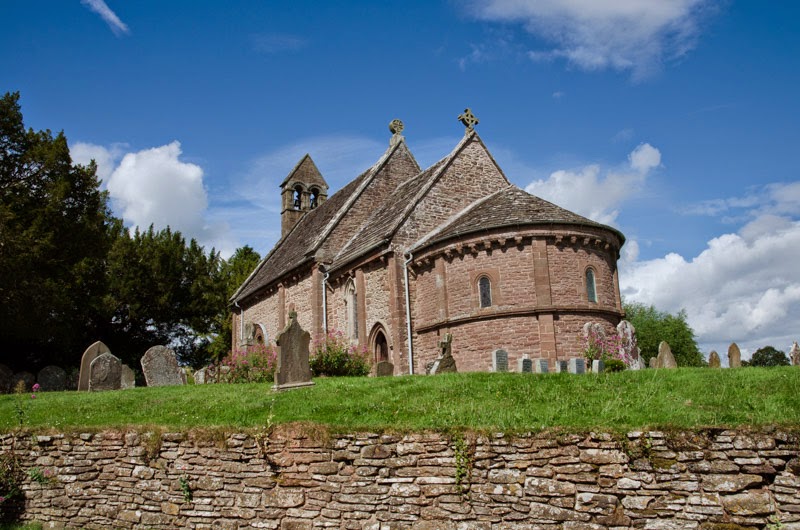
It is known to have been completed by 1140 and is built of the local pink sandstone. Its great age is apparent from the oval shaped churchyard. Some say that it is mounted upon an earlier Pagan site but this is conjecture only. According to the bumpf in the church the Celts believed that the devil could hide in corners and that he could only follow a straight line which is why the path leading up to the church is a zig zag.
The Norman carvings and corbels are a unique survival...somehow they escaped the destructive forces of the Puritans and can be seen today in their original places. The work is traditionally attributed to the Hereford School of Stonemasonry. "The Hereford School of Romanesque Sculpture" by Malcolm Thurlsby goes into depth on this aspect.
I think a small selection of photos from our trip will do the talking. The church is famous for its well preserved Sheela na gig. Often they have been defaced because of their crude nature. For those who want to know more there has been a specific project set up http://sheelanagig.org/ I am not personally a great fan...she's a bit of an old strumpet doing impossible things with her crinkum crankum so I am happy to have seen her but don't need reminding!
This is the rather splendid door....above in the arch there is a tree of life.
A foliate head...I of course like to think of it as a Greenman! No surprises there then!
The musician and the lovers.
The hound and hare.
Inside the church is a much plainer affair but I was tickled pink with the rather stout holy water stoop and the rib swallowers.
The whole thing is a most gloriously bonkers experience....rather like a Norman version of Alice Wonderland and gives us just a small peep into their lost world. Allow me to finish with this rather terrific example.
Arilx
The life and adventures of a mildly dotty old bird.
Monday, 14 July 2014
Sunday, 13 July 2014
The Wanderer Returns
Hellooooooo! I'm back to annoy you all having spent the last week or so nosing around in the beautiful Wye Valley. To ease myself back in gently I'm sharing a couple of quotes that caught my eye whilst I was away. The photo is of a piece of graffiti that charmed me on the local church door. I can only imagine that the individual behind this carving was not terribly popular when their handiwork was first discovered in 1532!
"Education is not the filling of a pail, but the lighting of a fire."
W.B.Yeats
"A mind once expanded can never return to its original dimensions."
Oliver Wendell Homes Sr
Arilx
"Education is not the filling of a pail, but the lighting of a fire."
W.B.Yeats
"A mind once expanded can never return to its original dimensions."
Oliver Wendell Homes Sr
Arilx
Thursday, 10 July 2014
Harmony begins with me.
Just a very quick pop in from me as I am stilll en vacances kicking my heels....once I'm safely ensconced back at GBT I shall bring you tales of holiday merriment but for now a lovely little quote I espied in Cardiff Bay. The city has been dedicated as a world peace site which exists to promote a strong sense of peace and fellowship between people of all nations.
"Peace is not merely the absence of war. Peace is the dynamic and energetic presence of love, harmony and oneness in the world family."
Sri Chinmoy
Arilx
"Peace is not merely the absence of war. Peace is the dynamic and energetic presence of love, harmony and oneness in the world family."
Sri Chinmoy
Arilx
Friday, 4 July 2014
A Brief Sojurn.
Be glad of the rest from my witterings dear chums for I am off on my annual hols for the next few days. Never fear upon my return to Gnat Bottomed Towers I shall be back to annoy you with indecent haste!
Arilx
Make sure you're all doubly naughty in my absence.
Thursday, 3 July 2014
It's not worth the salt.
The phrase harks back to when meat was salted to preserve it. Salt was expensive thus a piece of second rate meat but said to be "not worth the salt" and would thus not have been kept in this way.
Arilx
Arilx
Wednesday, 2 July 2014
Wee Beasties
The latest selection of little lovelies spotted on my recent wanderings.
A black neck moth. These are daytime moths and it's been quite a task to identify this.
Small tortoiseshell
Meadow Brown
Large skipper
Initially I thought that this was an oil beetle but Mr GBT Has Looked Into The Matter Further and informs me that it is a bloody-nosed beetle- so called because it exudes a nasty red fluid when attacked. I am a tad envious of his rather splendid jacket.
Arilx
A black neck moth. These are daytime moths and it's been quite a task to identify this.
Small tortoiseshell
Meadow Brown
Large skipper
Initially I thought that this was an oil beetle but Mr GBT Has Looked Into The Matter Further and informs me that it is a bloody-nosed beetle- so called because it exudes a nasty red fluid when attacked. I am a tad envious of his rather splendid jacket.
Arilx
Tuesday, 1 July 2014
Chancklebury
Chanklebury is the old name for Chanctonbury and the Ring was our choice of destination for yesterday's lunchtime picnic. We were short on time so a quick jolly was needed and this is a gloriously close beauty spot with stunning views to match. You can even see the IOW on a clear day. This is the view from the other side across the South Downs.
Chanctonbury Ring is an Iron Age Hill fort. Excavations have revealed that the ramparts date from 300BC. It is sited on the highest point...our ancestors weren't daft when it came to matters of defence. Quite how they managed to build ramparts on that scale [they are now much shallower than they once would have been] with the tools they had available still takes my breath away.
Archaeological digs have revealed that the Ring and surrounding area have been in use since Neolithic times. Stone age arrow heads and flint axes have been found along with Bronze Age pottery shards. I spent some time spouting forth to Mr GBT my theory that the rounded lumps on the ground before you reach the Ring looked very much to me like the remainder of burial mounds. I know all about such matters being an authority on such matters [not] but I am pleased to have discovered since carrying out further online investigations [ok nosings] that there were three early Bronze Age burial mounds which were excavated but yielded nothing. However, within another one was found a woman who died in her thirties with a Wessex style bronze dagger. This is the representation of her on our town's sundial
For many who are familiar with Chanctonbury it's easily recognisable by the trees planted upon it. Originally these were beech trees planted by Charles Goring in 1760. They have even given rise to their piece of weather lore.
"When old Mother Goring's got her cap on we shall soon have wet"
They were decimated by the Great Storm in 1987 but this did allow the site to be more fully explored. It is now known that the Romans built two temples there. In the intervening period new trees have been planted and the Ring is beginning to look more like its former distinctive self once again.
Within the vicinity of the Ring are two dew ponds. One is possibly neolithic whilst the other was constructed c1870. These type of ponds are for livestock who graze on chalk land where there is no natural water. They are circular, up to 8' deep and built within a hollow. They were lined with puddled clay and also known as cloud ponds [details from Countryfile April 2014]
Naturally such a site attracts its own folklore. Legend has it that the devil build the Ring and if you run round it seven times widdershins the devil will appear and offer you a bowl of soup for your soul. If you were hoping to conceive then you were encouraged to spent a night up there to increase your fertility and the fairies can be seen dancing there on Midsummer's Eve. Nowadays it is noted for its paranormal activity and sightings of UFOs.
Arilx
Chanctonbury Ring is an Iron Age Hill fort. Excavations have revealed that the ramparts date from 300BC. It is sited on the highest point...our ancestors weren't daft when it came to matters of defence. Quite how they managed to build ramparts on that scale [they are now much shallower than they once would have been] with the tools they had available still takes my breath away.
Archaeological digs have revealed that the Ring and surrounding area have been in use since Neolithic times. Stone age arrow heads and flint axes have been found along with Bronze Age pottery shards. I spent some time spouting forth to Mr GBT my theory that the rounded lumps on the ground before you reach the Ring looked very much to me like the remainder of burial mounds. I know all about such matters being an authority on such matters [not] but I am pleased to have discovered since carrying out further online investigations [ok nosings] that there were three early Bronze Age burial mounds which were excavated but yielded nothing. However, within another one was found a woman who died in her thirties with a Wessex style bronze dagger. This is the representation of her on our town's sundial
For many who are familiar with Chanctonbury it's easily recognisable by the trees planted upon it. Originally these were beech trees planted by Charles Goring in 1760. They have even given rise to their piece of weather lore.
"When old Mother Goring's got her cap on we shall soon have wet"
They were decimated by the Great Storm in 1987 but this did allow the site to be more fully explored. It is now known that the Romans built two temples there. In the intervening period new trees have been planted and the Ring is beginning to look more like its former distinctive self once again.
Within the vicinity of the Ring are two dew ponds. One is possibly neolithic whilst the other was constructed c1870. These type of ponds are for livestock who graze on chalk land where there is no natural water. They are circular, up to 8' deep and built within a hollow. They were lined with puddled clay and also known as cloud ponds [details from Countryfile April 2014]
Naturally such a site attracts its own folklore. Legend has it that the devil build the Ring and if you run round it seven times widdershins the devil will appear and offer you a bowl of soup for your soul. If you were hoping to conceive then you were encouraged to spent a night up there to increase your fertility and the fairies can be seen dancing there on Midsummer's Eve. Nowadays it is noted for its paranormal activity and sightings of UFOs.
Arilx
Subscribe to:
Posts (Atom)
Titivillus
Had you asked me as recently as yesterday whether I knew what the word 'titivillus' meant I would have said no. Had you asked me whe...
-
Hello all you lovely peeps out there. Am back from my wanderings and reacquainting myself with the washing machine. It's a return to pa...
-
Almost inevitably last weekend featured yet more dancing from moi. This time we were at a very local quirky show which we have performed at ...
-
David loves a map and is to be found quite often checking up stuff on Google. Usually it's me finding the oddities, but this one is ent...


